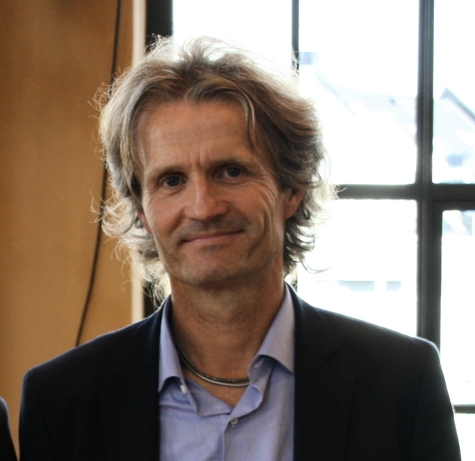
Picture from Eurocomb 2015 in Bergen
Jan Arne Telle
You have reached the English homepage of Jan Arne Telle.
On my Norwegian homepage I have some Newspaper articles in Norwegian.
University of Bergen
Department of Informatics
Postboks 7800, 5020 Bergen, NORWAY
Office: : HIB room 3102
Ph. : +47 55-58-40-36
Mobile : +47 93-22-56-19
Fx. : +47 55-58-41-99
E-mail : telle-at-ii-dot-uib-dot-no
Professor and member of the Algorithms Research Group at the University of Bergen.
2022-2026 I lead a project sponsored by the Norwegian Research Council called
Machine Teaching for Explainable AI.
Fall 2022 I teach INF339 Mathematical Models of Machine Teaching for XAI
Here is a list of publications with some hyperlinks.
And here is what Google Scholar says about citations to my publications
For more information please contact me directly or look at my CV in pdf
I am a computer scientist with broad research interests mainly within the areas of algorithms,
computational complexity, combinatorics and its applications. Much of my work concerns the search for hidden
structure in input data and the efficient use of this to solve hard computational problems. For example,
a recent paper in JAIR (Journal of Artificial Intelligence Research) improves the state of the art for the
model counting problem by techniques coming from modern graph decompositions. I have also worked on models
for the design of efficient and scalable parallel algorithms. Recently an interest in machine learning, based
on big data, has led to an investigation of machine teaching, based on carefully selected data, and its use for XAI.
In addition to subjects like these, I enjoy teaching basic programming and discrete mathematics, and have developed
a new course on the theory of social networks. As board member of the Norwegian Olympiad in Informatics I am engaged
in the promotion of programming competitions as part of the educational experience.
Much of my research is on graph algorithms. Graphs are used to reason about pairwise (2-way) relationships
between entities. We focus on 2-way relationships because one-way relationships are too weak and k-way relationships
for k>2 adds complications without strengthening in an essential way. Graphs are important because many applications
concern situations modeled as a graph, i.e. a collection of nodes with edges between them, such as: html links between
web pages, flights between airports, road segments between intersections, email/friendship/likes/etc between people on
social media, calls between subroutines in a computer program, contact between people eg. for the study of infection,
chemical interactions between proteins etc. The same types of problems and algorithms turn out to be
important in many of these applications. By removing the application-specific parts and viewing it as a graph, we can
solve all these problems only once, by a good algorithm, instead of solving them repeatedly for each application.
------------------------------------------------------------------------------
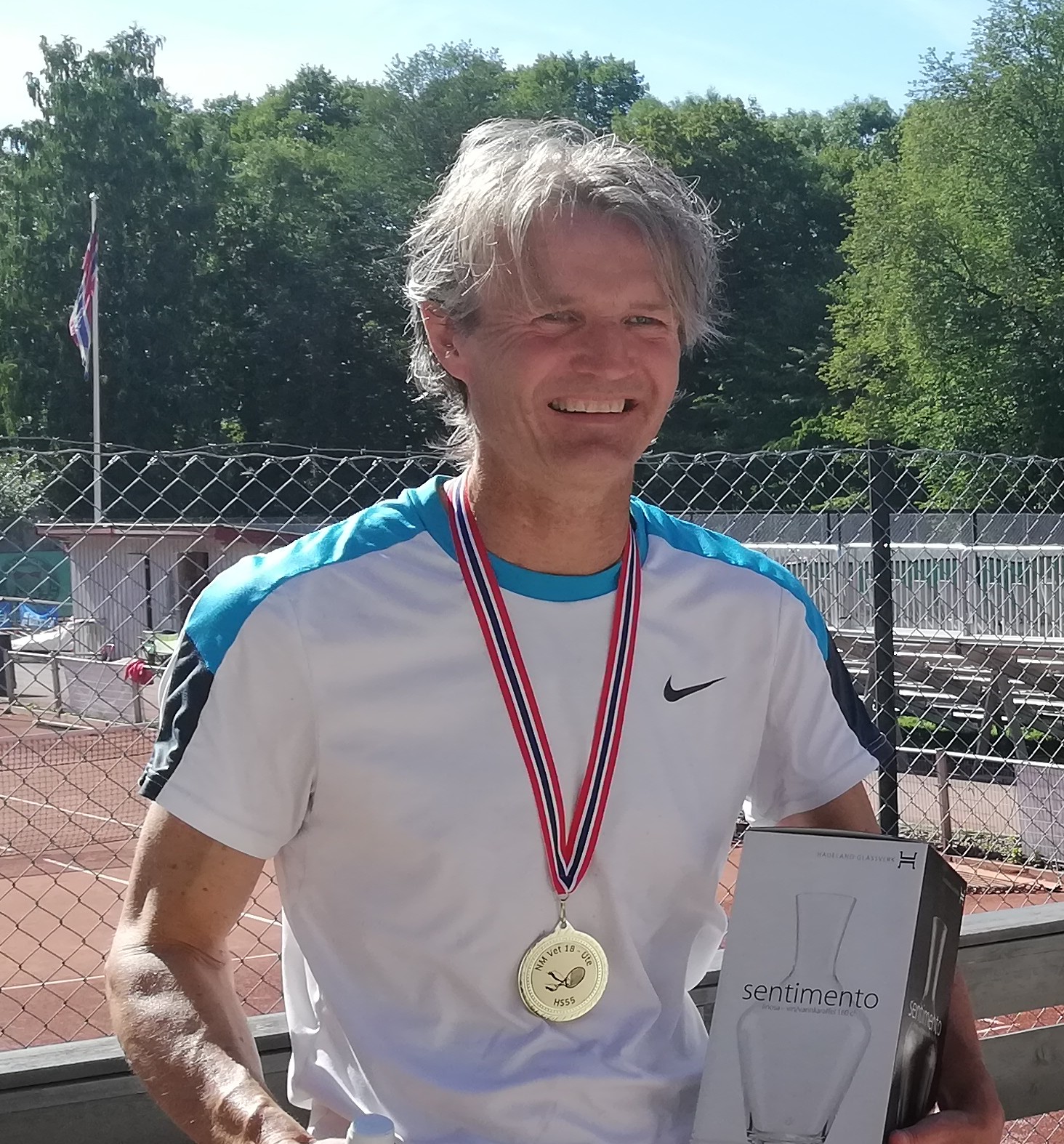
I play tennis for the fun and the competition. Picture from the Norwegian Veterans Championship 2018.
------------------------------------------------------------------------------
Sometimes I like to while away my time reading some good quotes, aphorisms, poems:

"Truth can never be told so as to be understood, and not be believed." (W.Blake)
"Challenge your (mathematical) intuition, because when it fails you can really learn something new."
"Agree with me if I seem to speak the truth" (Socrates)
"...while in the past it was regarded as the purpose of our programs to instruct our computers, a shift
to the opposite view could now take place, viz. that it is the purpose of our machines to execute our
programs." (E.Dijkstra -on the appearance of mathematical semantics for programming languages)
"I would rather have today's algorithms on yesterday's computers than vice versa." (P.Toint)
"True wisdom is to know the extent of what you don't know
quite as well as you know what you do know."
"The universe may be as great as they say, but it wouldn't be missed if it didn't exist." (P.Hein)
"If this is tea then give me coffee and if this is coffee then give me tea." (Airline passenger)
"Do you really believe in this superstition? Well, I have been told it works even if you do not
believe in it." (Niels Bohr -commenting on a horseshoe by the entrance to his laboratory)
"A ritual to read to each other.
------------------------------
If you don't know the kind of person I am
and I don't know the kind of person you are
a pattern that others made may prevail in the world
and following the wrong god home we may miss our star.
For there is many a small betrayal in the mind,
a shrug that lets the fragile sequence break
sending with shouts the horrible errors of childhood
storming out to play through the broken dyke.
And as elephants parade holding each elephant's tail,
but if one wanders the circus won't find the park,
I call it cruel and maybe the root of all cruelty
to know what occurs but not recognize the fact.
And so I appeal to a voice, to something shadowy,
a remote important region in all who talk:
though we could fool each other, we should consider-
lest the parade of our mutual life get lost in the dark.
For it is important that awake people be awake,
or a breaking line may discourage them back to sleep;
the signals we give - yes or no, or maybe -
should be clear: the darkness around us is deep."
(William Stafford)
"Look for awhile at the China Cat Sunflower,
proud-walking jingle in the midnight sun.
Copper-dome Bodhi drip a silver kimono,
like a crazy-quilt stargown,
through a dream night wind.
Krazy Kat peeking through a lace bandana,
like a one-eyed Cheshire,
like a diamond-eye Jack.
A leaf of all colors,
plays a golden string fiddle,
to a double-e waterfall over my back.
Comic book colors on a violin river,
crying Leonardo words,
from out a silk trombone.
I rang a silent bell,
beneath a shower of pearls,
in the eagle wing palace,
of the Queen Chinee." (Robert Hunter)
"Is my understanding only blindness to my own lack of understanding?
It often seems so to me." (Ludwig Wittgenstein)
"We have not succeeded in answering all of our problems. The answers we have
found only serve to raise a whole set of new questions. In some ways
we feel we are as confused as ever, but we believe we are confused
on a higher level and about more important things." (Source unknown)