Difficulty: Summer: YDS class 1, Winter: YDS class 2.
Climbed October 23. 1999 and August 12. 2016.
Information:
How to get there:
This description starts at Narita international airport,
prices quoted reflect the end of 1999. There seems to be
two options using public transportation:
1) By train. Train (Japan rail) from Narita to Otsuki, then
with a private railroad from Otsuki to Kawaguchiko,
a village at the foot of Mount Fuji.
The cost is about 4000 yen. I had to
make numerous changes due to some train accident,
in theory one should be able to complete this trip
with 3 trains (it took me 6 trains and 6 hours).
2) By train and bus. Take Japan rail from Narita to Shinjuku,
then express bus from Shinjuku to Kawaguchiko.
The cost is about 3000 yen. I used this on my return
trip, it was substantially faster.
In Kawaguchiko, there is a youth hostel that provides economy
lodging. I had no reservations, and no membership, the cost was
then about 3800 yen per night. Ask directions at the train/bus
station, it is about a 5-10 minute walk. Note added August 12, 2016;
We came by car from the south and parked at the large Mizugatsuka parking (pay) lot.
(Location of parking is N35.30582, E138.77135, elevation about 1450 meter.)
From there, a shuttle bus (about 1000 yen/person) took us to the 5th. Station
of the Fujinomiya Trail. This location is at N35.33657, E138.73328, elevation
about 2380 meter. Route description:
The Japanese have divided Fuji into "stations", the first being
at the very base, the 10th being on the crater rim. There are several
routes up, the one I describe is likely the most common. On this
route there is a big road leading up to the "5th station", where there
is parking and a lodge style cafeteria etc.
There are buses that go to the 5th station, Fuji-subaru-line, from
Kawaguchiko, but the first one leaves too late for a full day on the
mountain in the late fall/winter season. A one day climb therefore
requires a taxi (or other means of transportation by car). The taxi
ride had a fixed price of 12.300 yen, so it is good if one can
share it with somebody. Note added August 12, 2016;
The route from the 5th. Station of the Fujinomiya Trail, is straightforward.
The trail arrives at the crater rim close t the highest point, turn left and
ascend a final slope of loose scree. Observations:
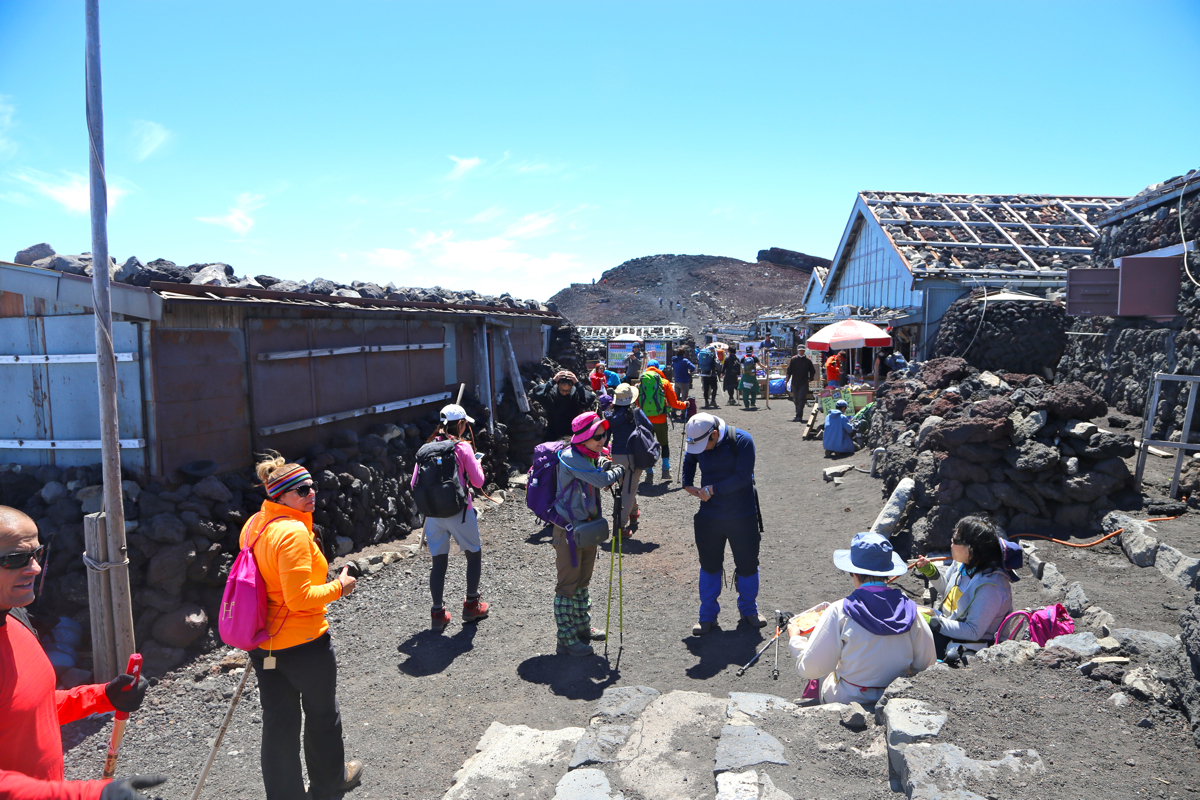
The official "climbing season" is July and August. In this period
there are open huts and services along the entire trail including what
looks like a small village at the crater rim. As many as 3000 Japanese
make the climb each day, so this period should be avoided.
Outside of the season, there are no services, the mountain is much
more quiet, but it is a fine, and not too difficult climb provided
that you have the required equipment for snow climbing at high altitude.
Here is a summary of my own observations:
Start from the 5th station (subaru line) at 0630 on October 23rd, 1999.
There were traces of snow at the end of the road. The trail actually
decends a bit as it traverses left to a point where things finally are
pointing upwards. Clearly marked trail with many (closed) huts along the way.
I reached the 3000m level at 0810 and the crater rim at 1030. The wind was gusty,
some snow drifts, but beautiful weather. Kawaguchiko was in fog in the early morning
while the sun's first rays illuminated the mountain in a yellow light. Two stone
lions welcome you to the rim where a small "village" of stone cabins filled up
most of the available space.
The highest point on the rim is exactly opposite of my point of arrival, so
I set out (clock-wise) to complete the crater rim walk. No footprints, about
30-40 cm of snow, enough to notice breathing a bit, in particular in the small
uphills. The hike to the highest point was straightforward. From the highest
point there are two alternatives, I stayed on the highest ridge and eventually
climbed down about ten meters on a metal ladder. One can trivially hike back along
an interior route, I decided to follow the rim and that route passes another local
summit. This top can be climbed left (or outside, this is most likely the official way)
or right (inside), which was what I did.
I left the crater rim at 1230 after two hours without company, but with a
magnificent 360 degree look at Japan. Back at station 5 after 1:45, including a significant
navigational error at station 8. The trail forks here and the subaru-line trail bears
left. I went straight down without much thinking and realized my error in the
vicinity of station 7. From here I made a long decending traverse to the left in order
to get back on track around station 6. Comments:
The first snow on Fuji fell Thursday morning October 21.
It made Fuji appear on the front page of The Japan Times under
the headline "zipped up for the winter" which
I read on Friday while travlling by train from Narita to Kawaguchiko.
The route I followed has absolutely no technical parts, just hiking on
a moderately steep snow slope. It is clear, however, that crampons
and an ice axe may be absolutely necessary if the slopes gets icy or
develops a hard crust on the surface. The wind on the top was very gusty,
almost storm at one moment (with strong snow drift), then calm and quiet
a few moments later. After the arrival of the snow, this mountain certainly
requires proper mountain winter gear. Note added August 12, 2016;
The hike from the 5th. Station to
the crater rim along the
Fujinomiya Trail, took us 2 hours and 10 minutes, 10 minutes certainly spent
waiting in order to pass several hundred climbers that generally moved very
slowly. We started at 0800, and enjoyed the view from the highest point together
with a rather large crowd,
including what looked like a couple of (elementary school)
classes of children.
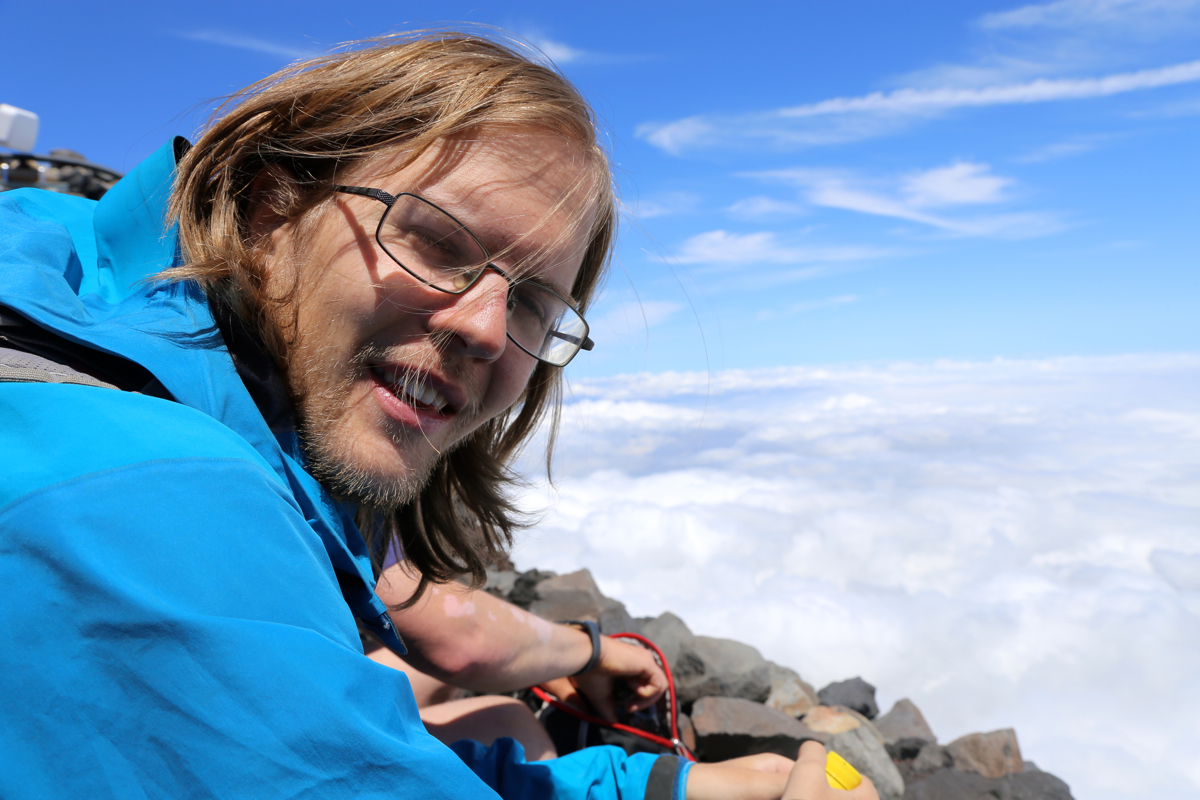
Pål Jørgen climbed Fuji in 2015 as a backpacker, that is, he carried all his belongings
including his (heavy) laptop etc. all the way up. I had good memories from my solo-winter climb 17
years earlier. It was therefore very nice to be back on top,
this time together.
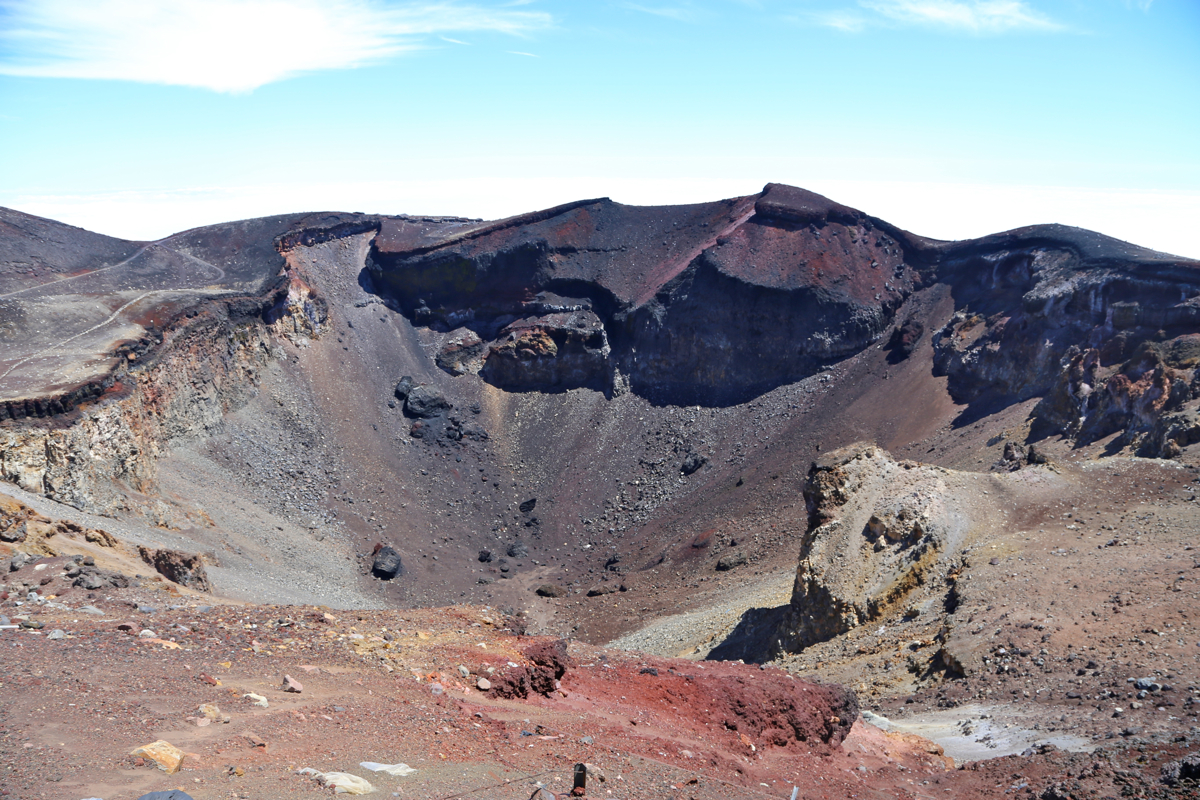
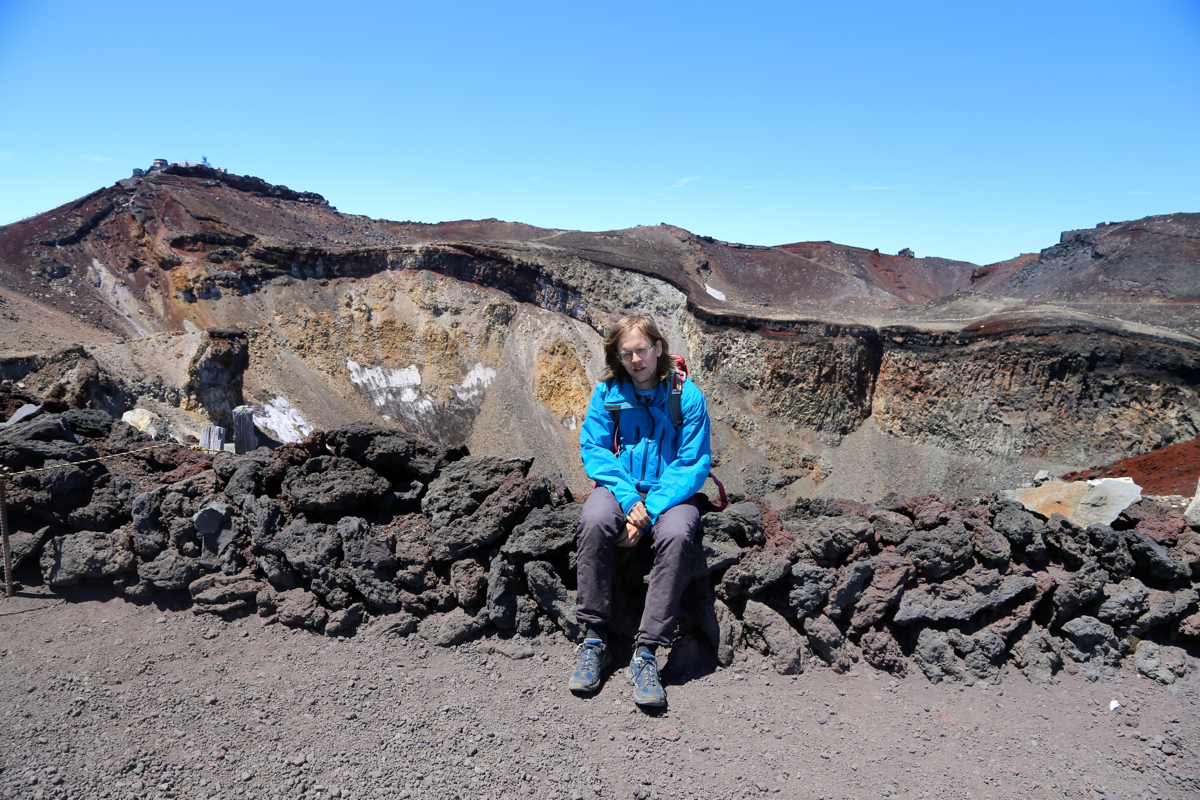
The crater and the summit area looks very different in summer.
Wide walking paths everywhere.
We eventually left, walked down from
the highest point,
then strolled around
the crater with another
stop for
refreshments at "the village"
opposite of the highest point.
Returning to
the top of the Fujinomiya Trail, we descended in 1:35, to arrive at the 5th. Station
at 1325. A bus quickly got us back down to our parked car. A very nice, but sort of
"unreal" day. In Bergen, we have a "mass hike" of the city mountains once a year, on
Mount Fuji, a similar large scale event takes place every day throughout the
hiking season. Final Note:
I noticed information that one is supposed to file an application with the police
and then have this approved, in order to climb Mount Fuji outside of the "official season".
Little did I know about this back in 1999. I just flew in from Norway and ascended
the peak the next morning without informing/talking to anybody.